
PMI increased from 52.0 in August to 56.8 in September -- highest since January 2012.
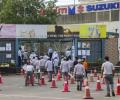
Top companies across sectors -- automobile maker Maruti Suzuki, consumer electronics giant Samsung to IT giant Infosys -- have reopened factories and offices as India took its first steps towards resuming economic activity after weeks under a near-total coronavirus lockdown.

First-time buyers of cars and sport utility vehicles (SUVs) have made a comeback, shows last year's data from top passenger vehicle (PV) makers. If the trend persists, it may move the needle on the overall car penetration ratio. India's car penetration ratio is 32 per 1,000 people - one of the lowest, compared to mature car markets like the US and Europe.

ICICI Bank was the top laggard in the Sensex pack, sinking over 10 per cent, followed by Bajaj Finance, HDFC, IndusInd Bank, Axis Bank and Maruti. Bharti Airtel and Sun Pharma were the gainers in the BSE index. NSE Nifty suffered a heavy loss of 566.40 points, or 5.74 per cent, to settle at 9,293.50.

'Some of the launches may get deferred due to the semiconductor shortage, which is unlikely to get resolved before the second half of 2022.'

American refiners closed some of their production, leading to futures trade benchmarked to the West Texas Intermediate going negative.

Car makers are trying hard to boost sales in India.

Automakers are caught in a chicken-and-egg situation: Prices have to come down if volumes are to increase, and volumes won't increase unless prices come down, notes Pavan Lall.

The company's buy of Concur will strengthen its position in cloud computing
